Technical Report

ABot-N1

The next-generation navigation model in the ABot series. Technical report has been released open-source simultaneously!

0
Core Tasks
0
Benchmarks
0
Paths
0
3D Scenes
0
Coverage
Technical report HuggingFace Visualization

ABot-N1 Overview

ABot-N1 Overview

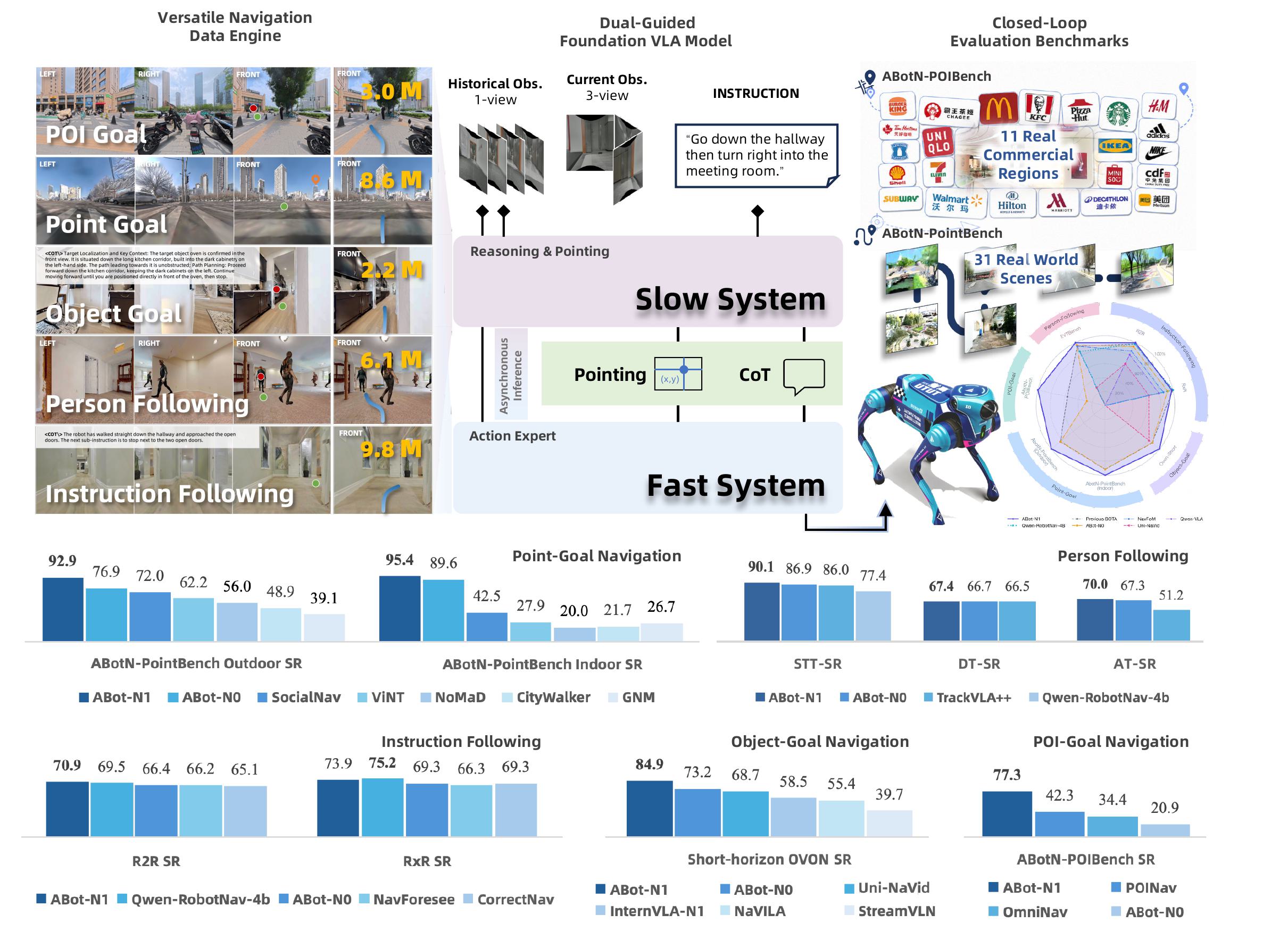
ABot-N1 is a step toward a general Visual Language Navigation foundation model, designed to address the limitations of monolithic black-box policies, including coordinate drift, weak handling of long-tail semantics, and limited interpretability. By decoupling cognition from control with a slow-fast architecture guided by dual visual-language signals, ABot-N1 enables robust, generalizable, and transparent navigation across diverse embodied tasks. A slow vision-language reasoner performs explicit Chain-of-Thought reasoning and produces pixel goals as universal image-space anchors for point-goal, object-goal, POI-goal, instruction-following, and person-following tasks. A fast action expert then combines textual cues and pixel guidance to generate continuous waypoints at the native control frequency, bridging high-level intent and low-level control.


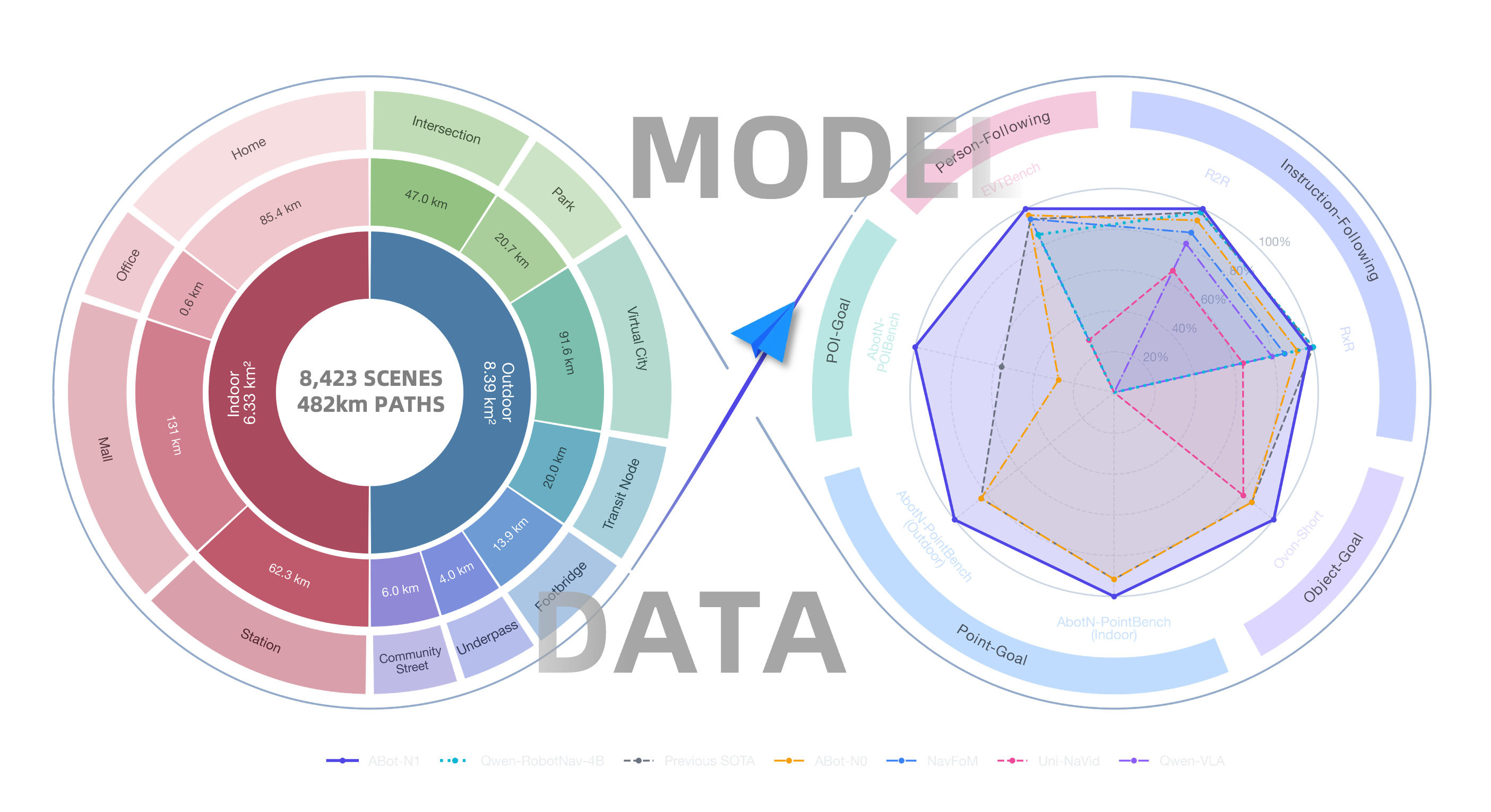
ABot-N1 achieves new state-of-the-art results, including a 35.0% gain in POI arrival to 77.3%, and 95.4% / 92.9% SR in complex indoor and outdoor scenes. We also release new open-source Point-Goal and POI-Goal benchmarks to advance urban-scale navigation.

ABot-N1 Contribution Overview

Point-Goal

Reach precise metric coordinates, serving as the foundational primitive for robust locomotion and obstacle avoidance.

POI-Goal

Identify Points of Interest and navigate to their physical entrances, bridging outdoor-indoor environments.

Object-Goal

Actively search for and navigate to specific object categories in unseen environments with semantic reasoning.

Instruction-Following

Execute long-horizon, complex natural language paths with rigorous linguistic-action alignment.

Person-Following

Real-time tracking of dynamic human targets — a critical social capability for human-robot interaction.

Asynchronous Dual-System Architecture

We introduce a novel dual ARCHITECTURE that factorizes cognition from control, combining deep visual-language reasoning with high-frequency action execution.

ABot-N1 Architecture
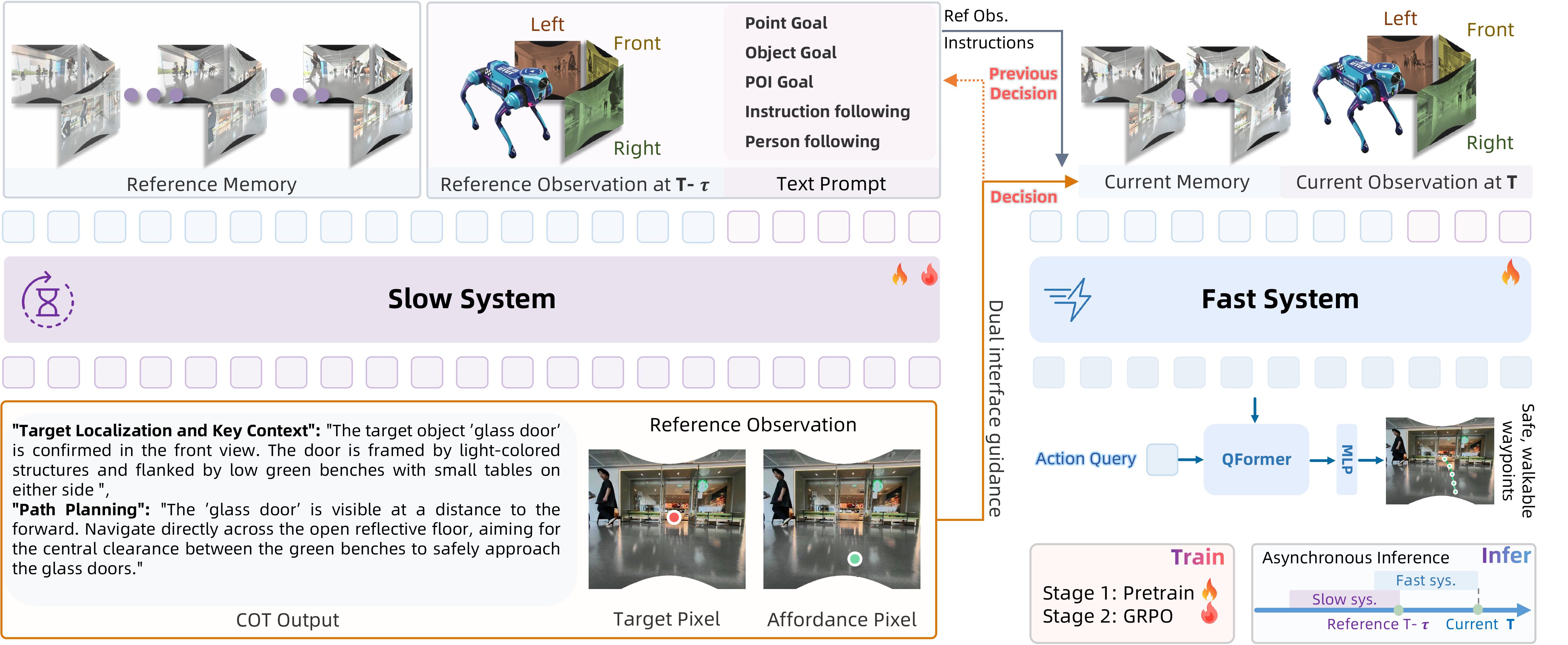
The Slow-Fast Dual-System Architecture of ABot-N1. Navigation is decoupled into asynchronous cognition and high-frequency control. Slow System (left): A vision-language reasoner processes historical frames and task prompts at low frequency, producing explicit CoT reasoning and visual anchors (Target Pixel and Affordance Pixel). Dual Vision-Language Interface (middle): The language and visual outputs form a unified bridge between the two systems. Fast System (right): A lightweight-VLM-based action expert integrates the dual guidance with real-time observations; a learnable action query attends to the output hidden states via a QFormer module, and an MLP decodes the queries to predict continuous waypoints. The system is trained with pretraining and GRPO, enabling complex reasoning without blocking the reactive control loop.
🧠

Deliberative Reasoner

The slow system leverages the Qwen-3.5-4B-VL model to perform explicit Chain-of-Thought reasoning over multi-view observations and historical memory. It outputs interpretable natural language traces alongside universal pixel goals to ground abstract intent in image space.

Action Expert

The fast system employs Qwen-3.5-2B as its backbone to jointly encode real-time observations with the slow system's reasoning traces and pixel goals. It distills these multimodal features into a sequence of continuous, adaptive SE(2) waypoints for precise and reactive control.

Asynchronous Inference

The slow and fast systems operate asynchronously, decoupling deep reasoning from high-frequency control. The fast system tracks cached pixel goals to ensure smooth, responsive navigation while the slow system deliberates.

Training Data Recipe

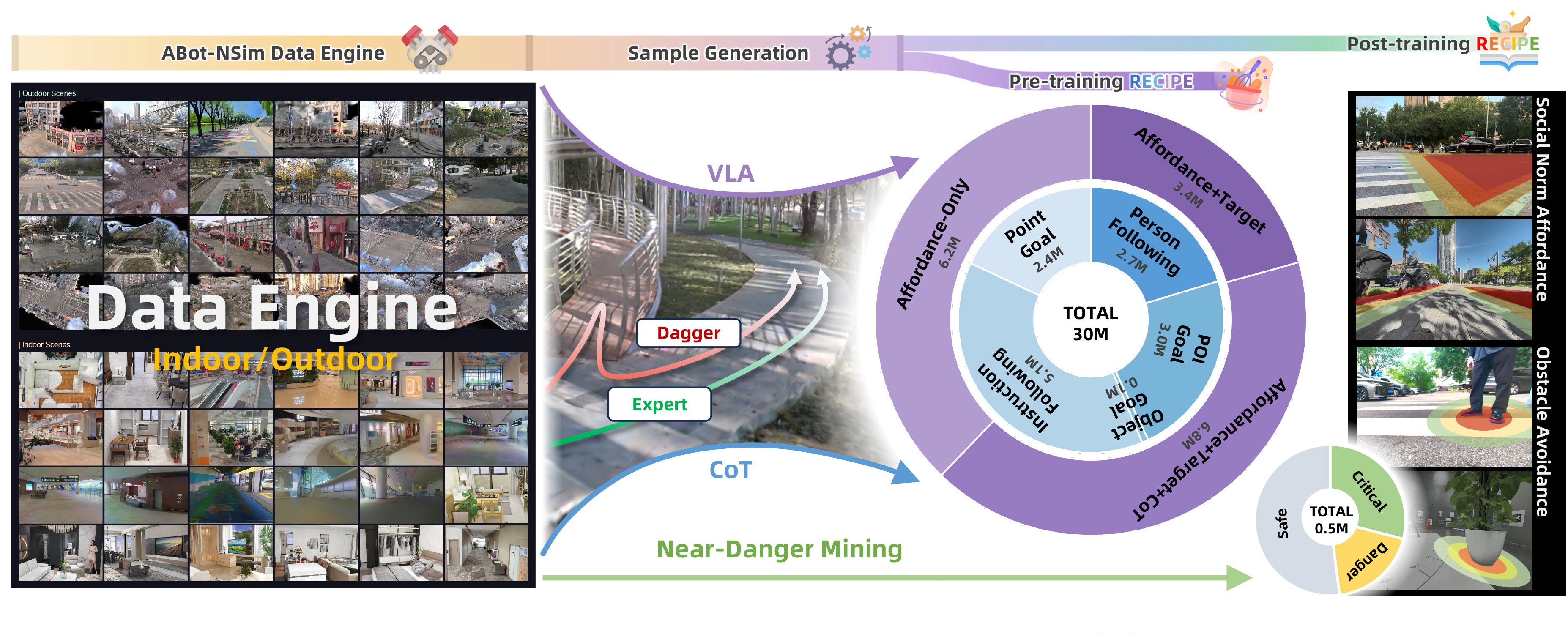
The ABot-N1 pre-training data engine integrates diverse 3D scenes and aggregates expert demonstrations across five core navigation paradigms, providing the essential supervision for both the slow reasoning system and the fast action expert.

30M
Pretraining Data
8,423
3D Scenes
14.7km²
Total Area Coverage
482km
Paths

Per-Task Data Breakdown

5 Navigation Tasks · 30M Trajectories Data

Point-Goal Data Pipeline
Point-Goal

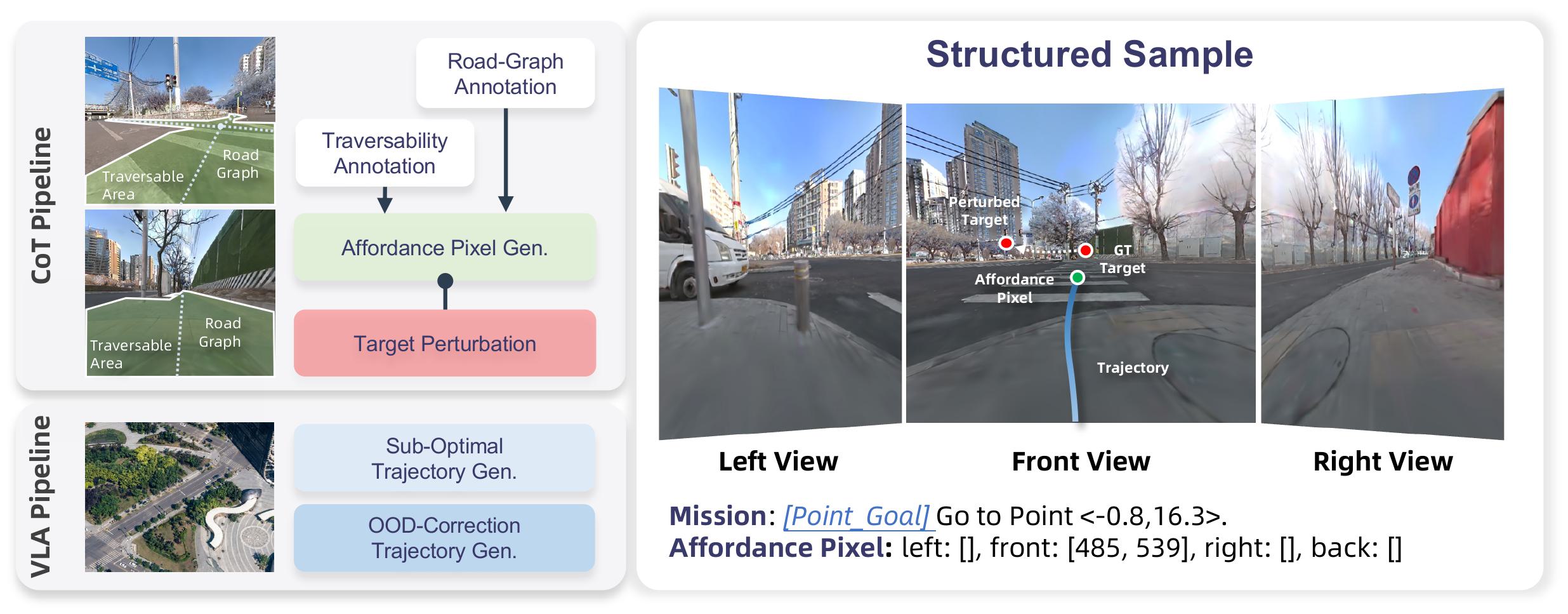
Left: the two-part data construction pipeline, including CoT data generation with affordance pixels and target perturbation, and VLA data synthesis with sub-optimal and OOD-correction trajectories. Right: an example structured sample with tri-view observations and affordance pixel annotations.

POI-Goal Data
POI-Goal

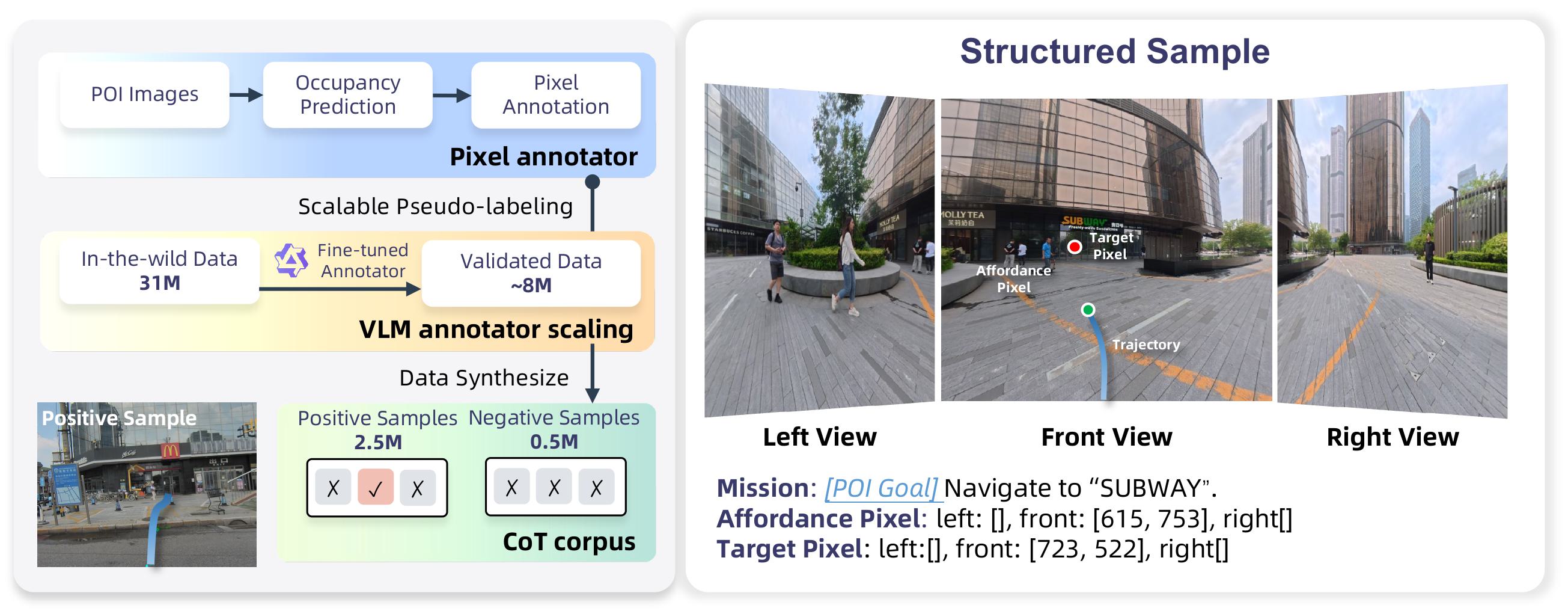
Left: a three-stage construction pipeline that generates geometric seed annotations via monocular depth, scales and filters 31M street-view pairs with a distilled VLM to obtain 8M valid paths, and synthesizes tri-view episodes into positive and negative sample pairs to improve rejection under missing-target conditions. Right: an example structured sample.

Object-Goal Data
Object-Goal

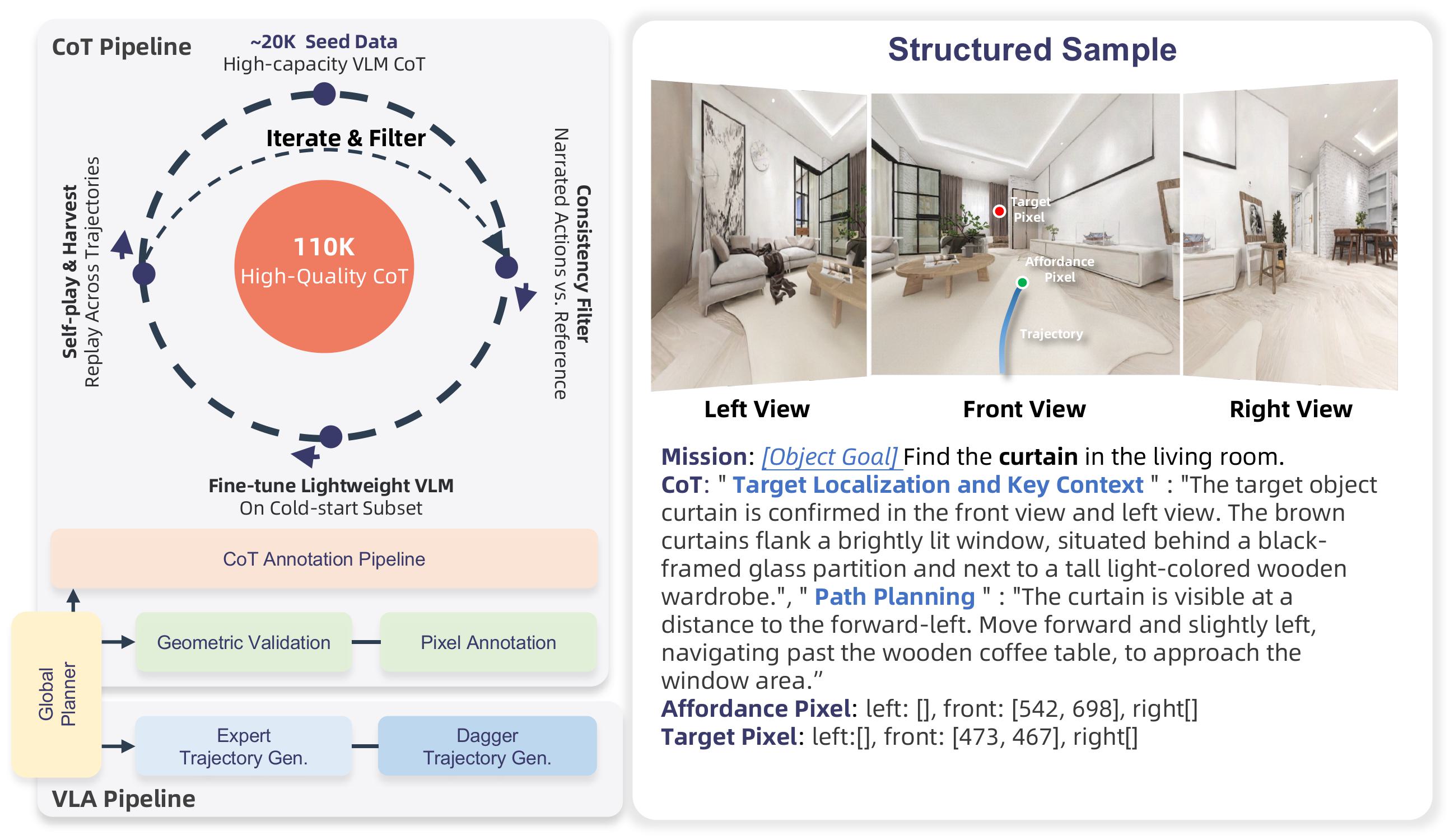
The left panel shows a two-part data pipeline: an iterative flywheel that scales VLM-seeded CoT rationales to 110K high-quality structured samples via A* consistency filtering and self-play harvesting, and a VLA pipeline that generates low-level supervision through pixel annotation and OOD-correction trajectories. The right panel shows the resulting structured tuple, with tri-view observations, object and affordance pixel grounding, and two-block CoT rationales.

Instruction-Following Data
Instruction-Following

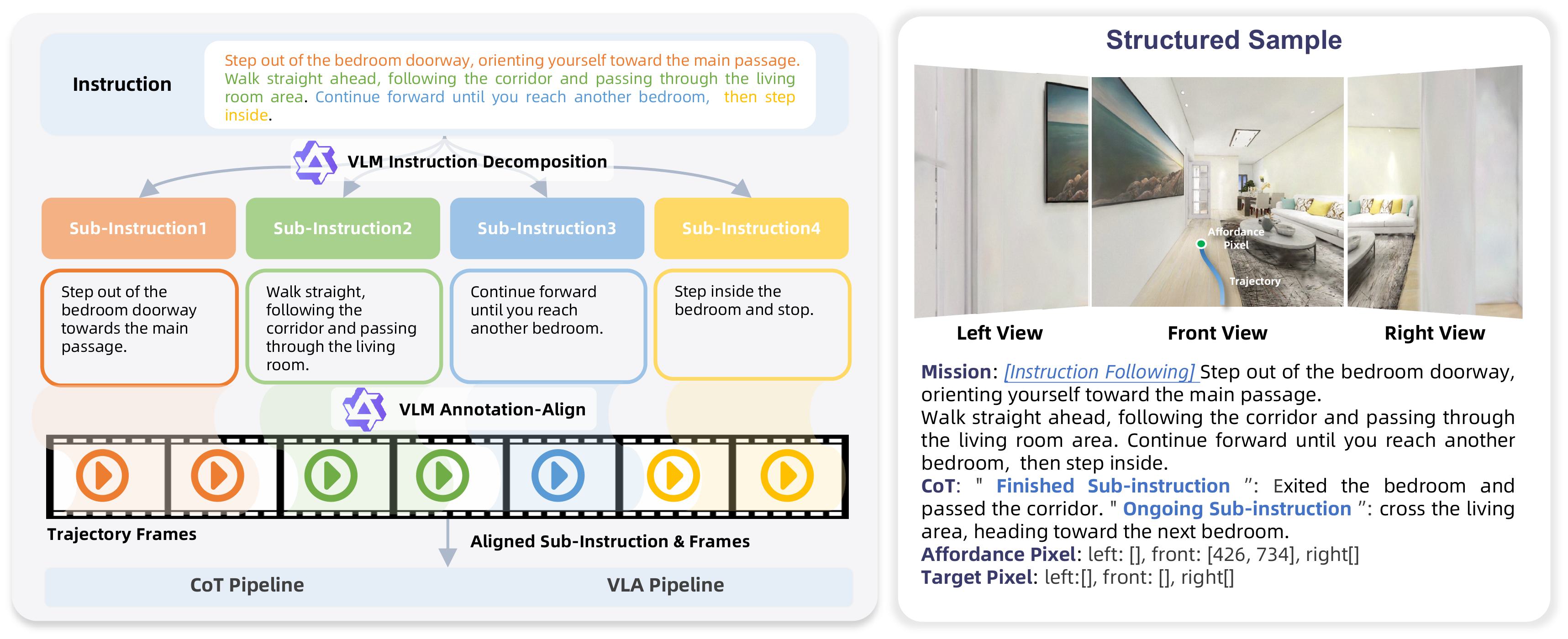
Left: a three-stage pipeline that decomposes long natural-language instructions into sub-instructions, aligns them with milestone frame ranges, and generates/verifies affordance and target pixels for CoT and VLA data. Right: an example structured sample with tri-view observations, language instructions, and pixel-level affordance and target annotations.

Person-Following Data
Person-Following

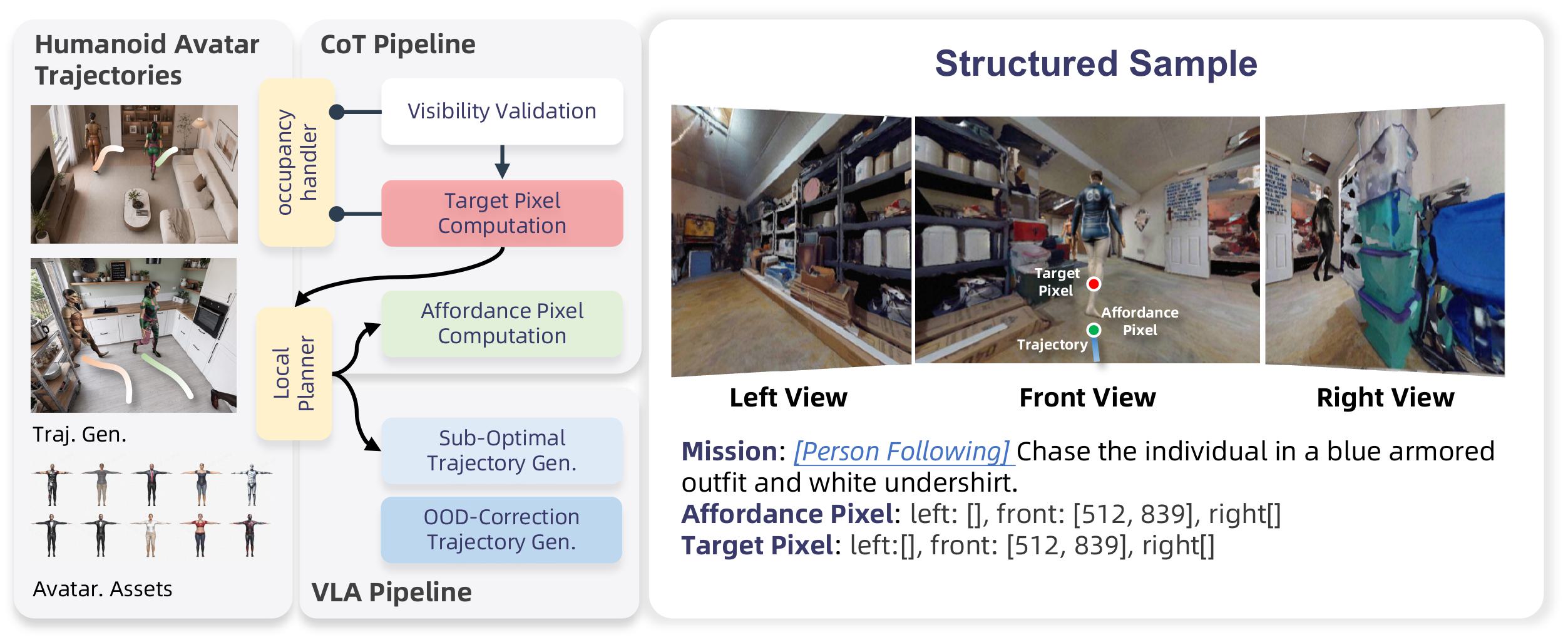
Left: a unified data construction pipeline for both CoT and VLA data, where CoT samples derive affordance and target pixels from human avatar trajectories via A* waypoint planning, visibility detection, and stochastic perturbation, and VLA samples are built from sub-optimal and OOD-correction trajectories. Right: an example structured sample with tri-view observations, affordance and target pixel annotations, and a language instruction describing the target appearance.

Training Protocol

ABot-N1 employs a progressive post-training pipeline that transforms the pre-trained foundation into a socially compliant, generalizable navigator. Training dynamics and generality analysis further validate the effectiveness of each stage.

Training Data Pipeline and Composition
Stage 1 · Pre-Training

Pre-Training

ABot-N1 initializes both systems from pre-trained Qwen-3.5 checkpoints. The slow system is trained with a cross-entropy loss for CoT tokens and pixel coordinates, while the fast system is supervised with smooth-L1 loss on position and heading angle, together with a binary arriving loss.

Unlike generic VLN settings, where smooth-L1 regression can suffer from mode collapse on multi-modal targets, ABot-N1 avoids this issue through its dual-system design. The slow system first makes the discrete decision with CoT reasoning and pixel-goal output, which concentrates the future-waypoint distribution into a dominant mode. Conditioned on these outputs, the fast policy faces an approximately uni-modal regression problem, making smooth-L1 stable and sample-efficient. Both systems are also trained with noise-injected inputs, such as perturbed target coordinates, noisy prior pixel predictions, and simulated asynchronous lag, to improve robustness against imperfect upstream signals during deployment.

Stage 2 · Post-training (GRPO)

GRPO-Based Alignment

To preserve pretrained capabilities during GRPO training, we avoid biased preference sampling and use action-balanced batch sampling to keep the data unbiased and training stable. This also helps prevent reward-hacking equilibria such as target withholding and permanent inaction by balancing target and safety rewards and adding a strong penalty for missing predictions.

The reward design is task-agnostic by construction: Rformat depends only on the output schema, and Rsafety depends only on scene geometry and traversability rules. Extending ABot-N1 to instruction-following, object-goal, or person-following requires only redefining Rtarget, and we validate the pipeline at scale on 0.5M point-goal episodes.

ABot-N Benchmark

ABot-N Benchmark Overview
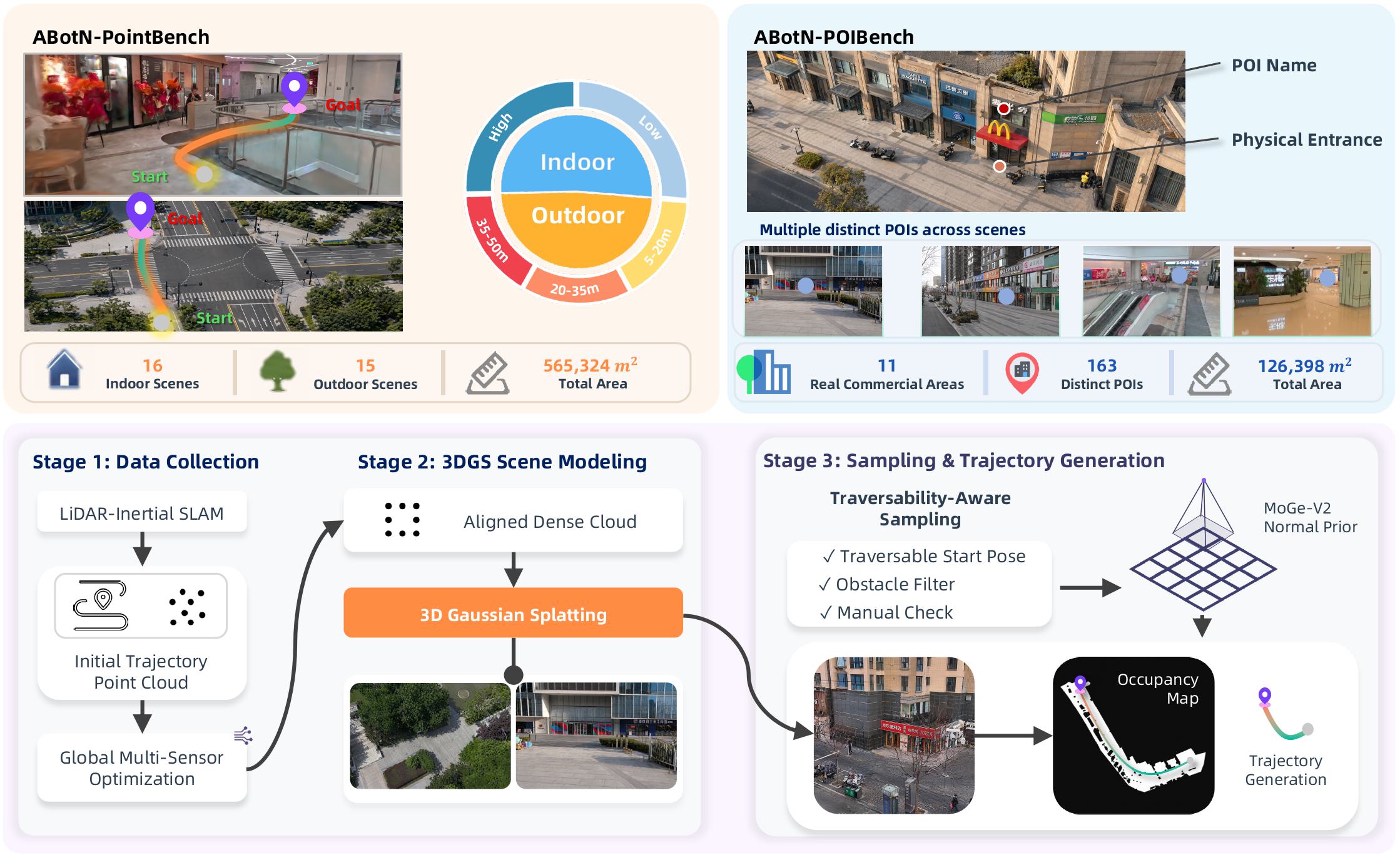
Overview of the ABotN Benchmark Suites and their Unified Scene Construction Pipeline. Top: dataset statistics and distance splits for ABotN-PointBench and ABotN-POIBench. Bottom: a unified three-stage pipeline that uses LiDAR-inertial SLAM for high-fidelity data collection, 3DGS modeling from aligned dense point clouds, and traversability-aware query sampling with A* reference trajectory generation on MoGe-V2-derived occupancy grids.
🎯

ABotN-PointBench

  1. ABotN-PointBench addresses key gaps in prior Point-Goal benchmarks, including scene homogeneity, open-loop evaluation, and missing social-rule compliance.
  2. It spans 31 real-world scenes across indoor and outdoor environments, with fine-grained walkability annotations and 465 reference trajectories.
  3. We evaluate with SR and SPL, measuring both navigation success and socially compliant closed-loop control.
🌍

ABotN-POIBench

  1. ABotN-POIBench fills the gap between open-loop waypoint prediction and coarse block-level POI evaluation, which miss entrance-level arrival accuracy.
  2. It covers 11 commercial regions and 163 POIs, with high-fidelity 3DGS reconstructions and physical entrance annotations.
  3. We evaluate with SR@2m and SPL, measuring final-meters arrival accuracy and efficient POI navigation.

Evaluation Results

ABot-N1 is evaluated across five navigation paradigms and seven benchmarks, achieving new state-of-the-art performance. Results are organized by task — select a tab to explore each benchmark.

Method SR (↑) SPL (↑)
AllLMH AllLMH
GNM39.166.732.018.736.765.328.416.5
ViNT62.292.050.744.062.292.050.644.0
NoMaD56.090.745.332.055.790.045.331.6
CityWalker48.973.340.033.348.372.239.732.8
SocialNav72.093.360.058.771.993.263.958.7
ABot-N076.993.372.065.376.993.372.065.3
ABot-N192.996.094.788.091.495.692.386.4
Method SR (↑) SPL (↑)
AllLH AllLH
GNM26.730.822.526.630.622.5
ViNT27.932.523.327.932.423.3
NoMaD20.020.819.219.620.518.6
CityWalker21.723.320.021.623.319.9
SocialNav42.546.738.342.546.738.3
ABot-N089.691.787.585.687.583.7
ABot-N195.495.095.893.793.394.2
Method SR↑ SPL↑ DTG↓
StreamVLN39.715.82.368
NaVILA55.426.11.811
InternVLA-N1 (S2 only)58.530.01.441
Uni-NaVILA68.734.51.495
ABot-N073.235.41.442
ABot-N184.951.80.822
Method NE↓ OS↑ SR↑ SPL↑
Uni-NaVILA5.5853.547.042.7
NaVILA5.2262.554.049.0
StreamVLN4.9864.256.951.9
CorrectNav4.2467.565.162.3
NavFoM4.6172.161.755.3
Qwen-VLA5.1069.057.351.2
ABot-N03.8070.866.463.9
ABot-N13.3275.270.967.5
Method NE↓ SR↑ SPL↑
Uni-NaVILA6.2448.740.9
NaVILA6.7749.344.0
StreamVLN6.2252.946.0
CorrectNav4.0969.363.3
NavFoM4.7464.456.2
NavForesee4.2066.353.2
Qwen-VLA5.8059.647.8
ABot-N03.8369.360.0
ABot-N13.1373.963.9
Method SR↑ SPL↑
ViNT19.018.2
OmniNav (vanilla)23.922.4
OmniNav (BridgeNav training)34.431.5
ABot-N020.917.7
POINav42.340.3
ABot-N177.372.6
Method Single-Target (STT) Distracted (DT) Ambiguity (AT)
SR↑TR↑CR↓ SR↑TR↑CR↓ SR↑TR↑CR↓
IBVS42.956.23.7510.628.46.1415.239.54.90
Uni-NaVid25.739.541.911.327.443.58.2628.643.7
NavFoM85.080.5-61.468.2----
TrackVLA++86.081.02.1066.568.84.7151.263.415.9
Qwen-RobotNav-4B77.490.06.40------
ABot-N086.987.68.5466.775.411.667.379.57.05
ABot-N190.189.84.2767.484.417.970.087.817.9

Deployment Visualization

Real-world deployment experiments across five core navigation tasks, demonstrating ABot-N1's execution precision and robustness in diverse environments.

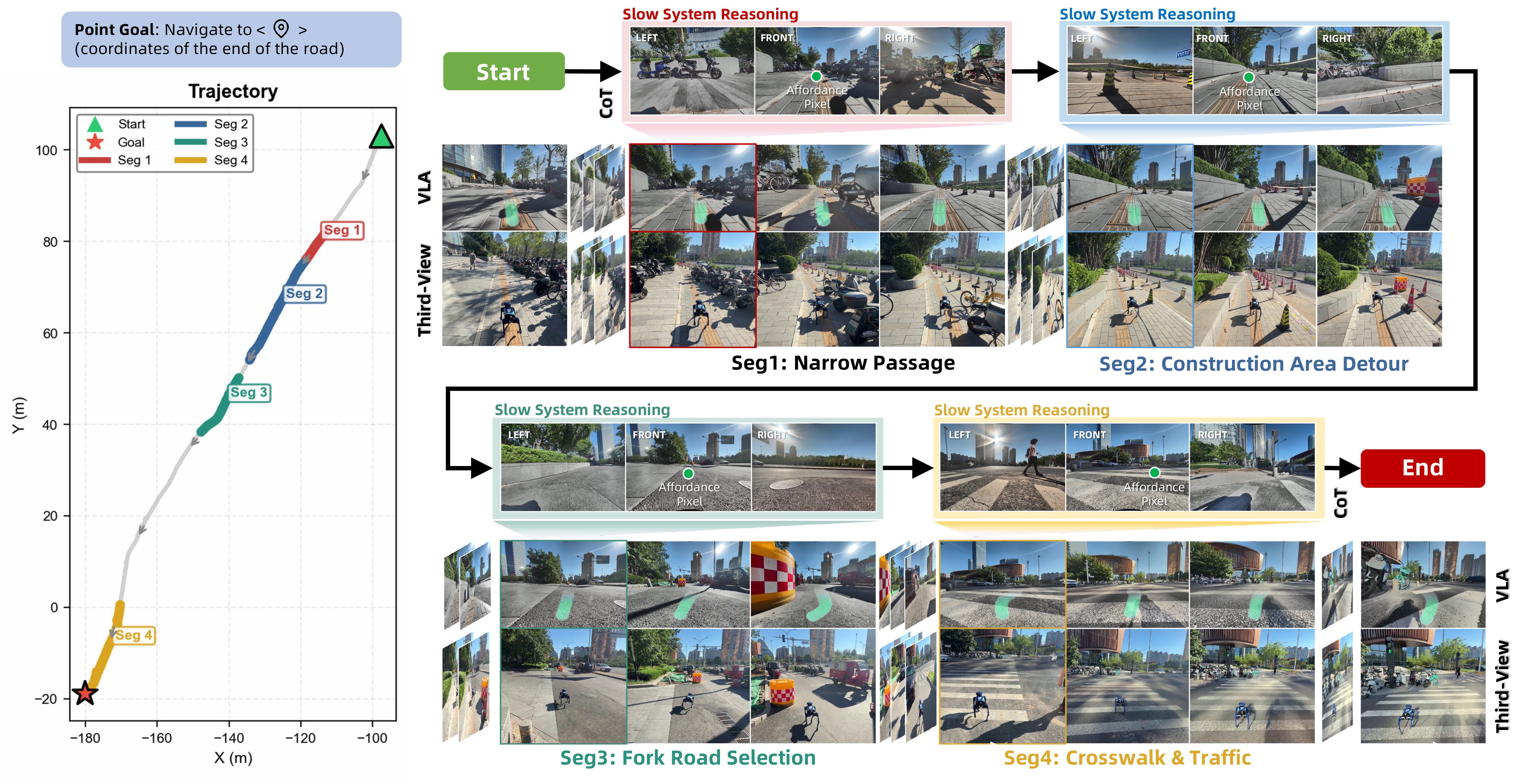
Point-Goal Deployment Visualization

Point-Goal Navigation

Four segments of a long-range outdoor episode showcasing obstacle avoidance on narrow roads, construction area detour, correct fork selection, and traffic-light-compliant crosswalk traversal.

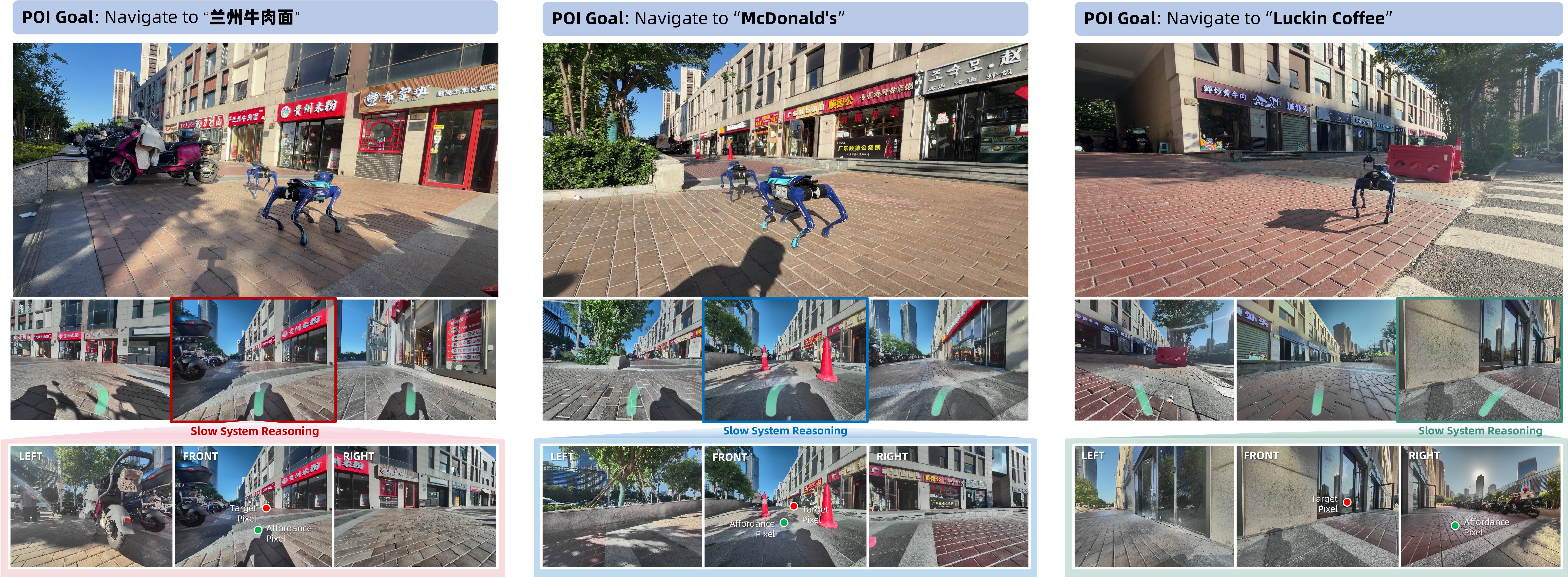
POI-Goal Deployment Visualization

POI-Goal Navigation

Locating a Lanzhou noodle restaurant (large viewing angle), McDonald's (obstacle avoidance en route), and Luckin Coffee (slope navigation and staircase avoidance).

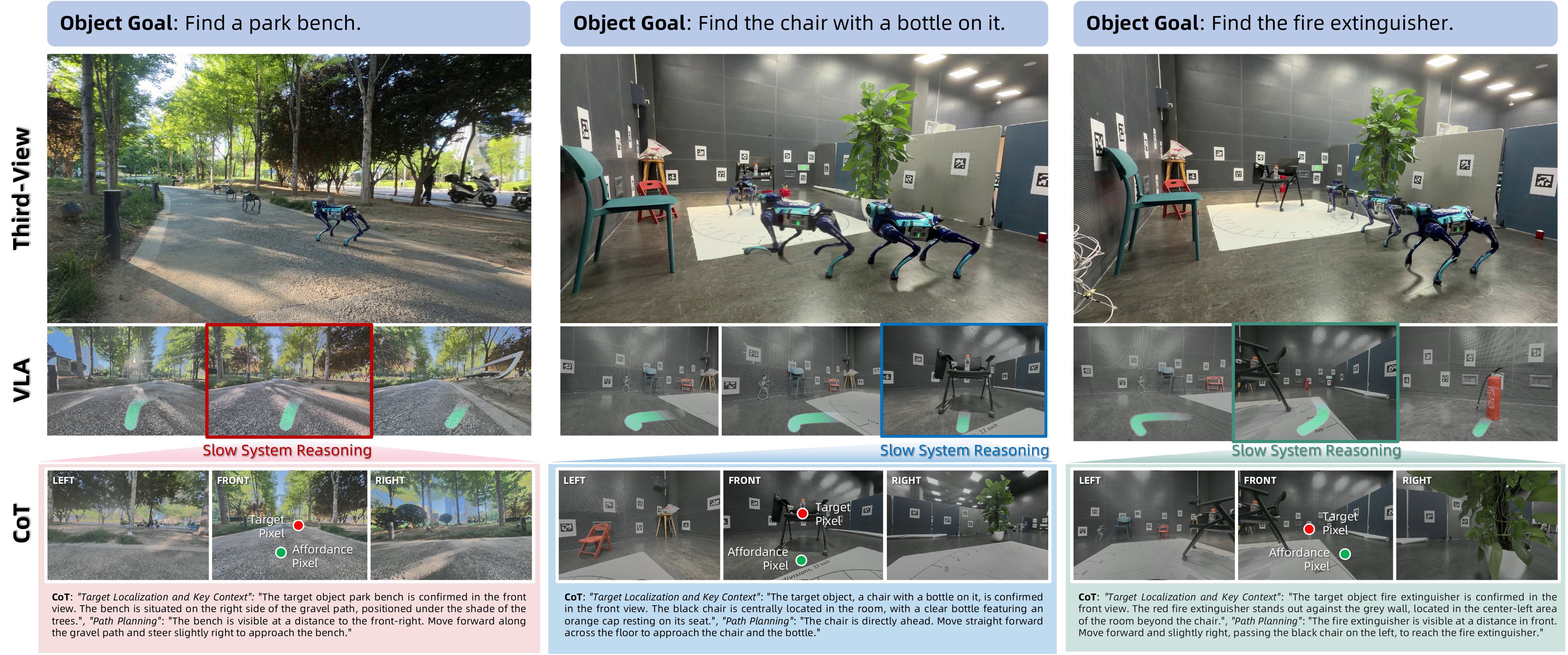
Object-Goal Deployment Visualization

Object-Goal Navigation

Three cases——outdoor bench under dappled tree shade at long range, indoor chair with a water bottle (spatial reasoning), and partially occluded fire extinguisher——with CoT, affordance, and target pixel overlays.

Instruction-Following Deployment Visualization

Instruction-Following

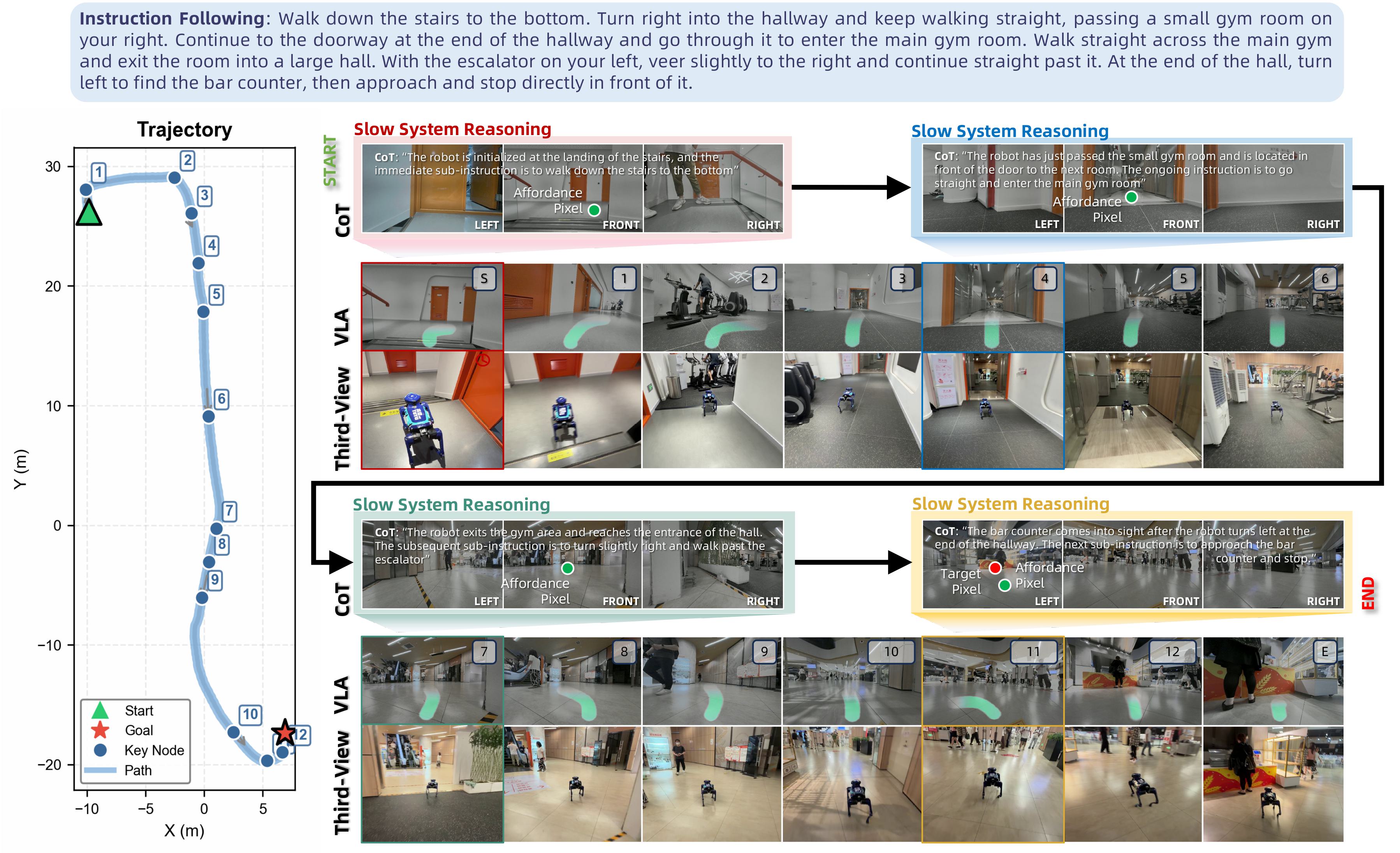
Slow-system reasoning at four critical moments——stair descent, gym entry, gym exit, and bar approach——with CoT, affordance pixel, and target pixel visualizations.

Person-Following Deployment Visualization

Person-Following

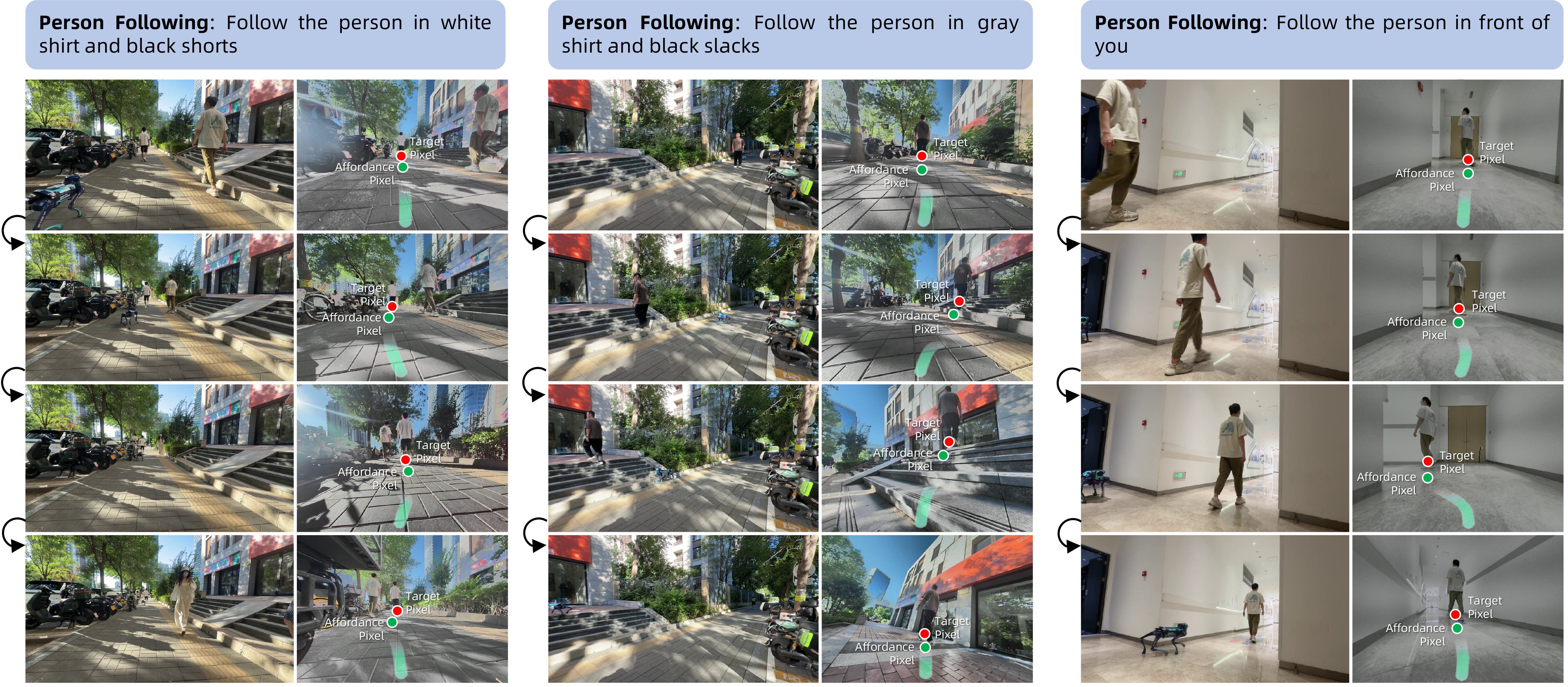
Outdoor tracking under pedestrian distraction, stair-climbing following, and indoor corner-rounding with temporary occlusion.

BibTeX

    @misc{2026abotn1generalvisuallanguage,
      title={ABot-N1: Toward a General Visual Language Navigation Foundation Model}, 
      author={AMAP CV Lab},
      year={2026},
      eprint={2607.10383},
      archivePrefix={arXiv},
      url={https://arxiv.org/abs/2607.10383},}